Q4 Savings on Clinically Characterized Samples — Reliable, Ready-to-Ship, and Designed to Support Your Research

Learn More

Point-of-care comparative study supports successful 510(k) clearance with CLIA waiver designation

April 28, 2026

Bringing a new diagnostic device to market is rarely straightforward. For companies developing point-of-care solutions, demonstrating substantial equivalence to an existing device while maintaining speed, quality, and cost efficiency can be a significant hurdle.

In this case, a small biotech company developing a novel point-of-care diagnostic for respiratory infections partnered with Boca Biolistics to navigate the FDA 510(k) pathway. The goal was clear: generate robust clinical and laboratory evidence to support regulatory submission while minimizing delays.

The Challenge: Proving Equivalence Without Slowing Down Development

The FDA’s 510(k) process requires clear evidence that an investigational product performs equivalently to a predicate device already on the market. This typically involves:

-Recruiting a sufficient number of eligible subjects
-Conducting parallel testing across clinical and laboratory settings
-Managing multiple vendors and workflows

These requirements can introduce complexity, extend timelines, and increase costs. For this study, an estimated 850 subjects with suspected respiratory infections were needed to meet positivity targets, adding further pressure to recruitment and execution timelines.

The Approach: Integrated Clinical and Laboratory Execution

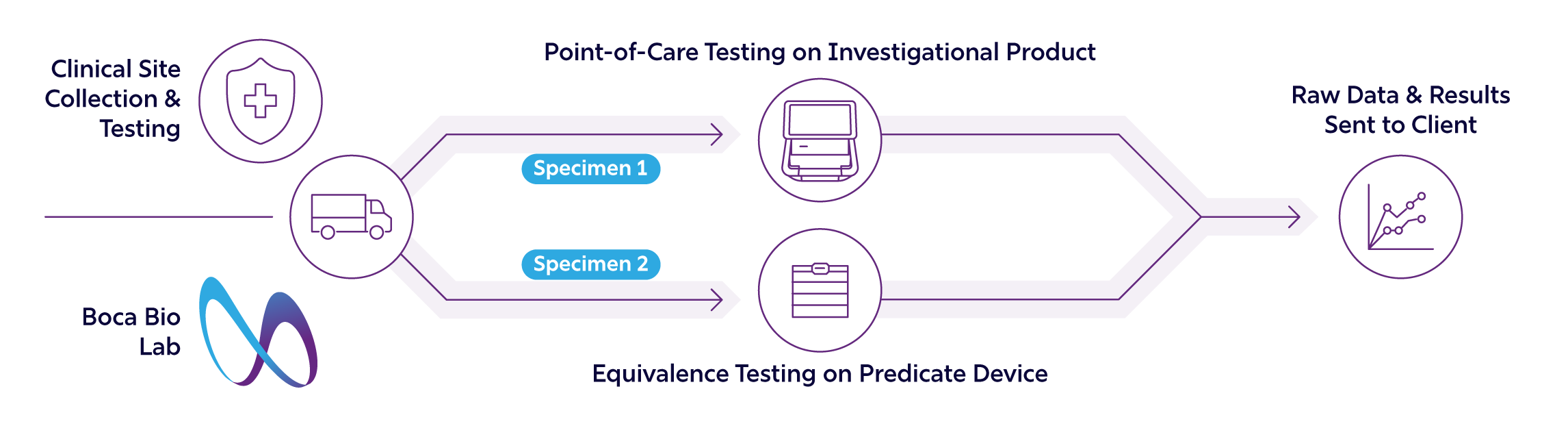
Boca Biolistics implemented a fully integrated study design that combined clinical site operations with centralized laboratory testing. The study was conducted across six clinical sites and included subjects aged 12 months and older presenting with symptoms of respiratory infection.

Each participant provided two nasopharyngeal swabs:

•One swab was tested on-site using the investigational point-of-care device
•The second swab was shipped to Boca Bio’s laboratory for predicate device testing

This dual-sample approach ensured a direct, controlled comparison between the investigational product and the existing standard.

To support regulatory requirements, clinical site staff were trained to operate within a CLIA-waived environment, aligning study conditions with real-world point-of-care use.

Speed and Efficiency Without Compromise

One of the defining aspects of this study was operational efficiency.

Despite being conducted outside peak respiratory season, the study achieved its recruitment goals with only 700 subjects, fewer than initially projected. Even more notably, the entire study was completed in just four months.

Laboratory performance also played a critical role. Equivalence testing was completed within two days of sample receipt, and raw data was delivered promptly to the client. This rapid turnaround enabled faster analysis and submission readiness.

Behind the scenes, rigorous quality control, inventory management, and chain-of-custody protocols ensured full sample traceability and data integrity throughout the process.

The Outcome: Successful 510(k) Clearance and CLIA Waiver

The results of the study met FDA requirements for substantial equivalence, leading to successful 510(k) clearance. In addition, the device received a CLIA waiver, allowing it to be used in point-of-care settings without the need for complex laboratory infrastructure or highly specialized personnel.

This dual achievement significantly expands the device’s commercial potential, enabling broader adoption across decentralized healthcare settings.

Why It Matters for Biopharma and Diagnostics Companies

This case highlights several critical success factors for companies navigating regulatory pathways:

-Integrated study design reduces complexity and vendor fragmentation
-Efficient recruitment strategies can shorten timelines even in challenging conditions
-Rapid lab turnaround times accelerate decision-making and submission readiness
-Strong sample traceability and quality systems ensure regulatory confidence

For organizations developing point-of-care diagnostics, the ability to combine speed with scientific rigor is essential.

Supporting Innovation from Study Design to Submission

At Boca Biolistics, supporting 510(k) submissions goes beyond sample collection. It involves aligning clinical execution, laboratory testing, and regulatory requirements into a cohesive, efficient workflow.

By delivering high-quality biospecimens, managing clinical sites, and providing rapid equivalency testing, Boca helps clients move from development to approval with greater confidence and speed.

As the demand for accessible, point-of-care diagnostics continues to grow, streamlined approaches like this will play an increasingly important role in bringing innovative solutions to market.

FAQ

How do you handle sample traceability?
Boca Biolistics maintains full traceability of all specimens and materials through a robust
chain-of-custody system, ensuring accurate tracking from collection to final delivery. Our
preservation protocols are designed to sustain sample integrity, utilizing validated
temperature controls and specialized packaging solutions.
During handling and shipping, all materials are managed in accordance with regulatory
standards and industry best practices, with continuous monitoring to safeguard quality
and reliability throughout transit. Specimen quality is our top priority, enabling our clients
to achieve the best possible outcomes and advance their research, leading to safer,
more effective products for patients.

Can you accommodate longitudinal study designs? Can you recall donors?
Yes, Boca Bio can prospectively collect samples at multiple time points. Check out this
immunization study to learn more about recallable donors.

Can you collect specific datapoints?
Yes, Boca Bio uses electronic data capture (EDC) to ensure your team has all the
clinical metadata they require.

How do you ensure sample traceability?
Boca Bio maintains full traceability of all specimens and materials through a robust
chain-of-custody system, ensuring accurate tracking from collection to final delivery. Our
preservation protocols are designed to sustain sample integrity, utilizing validated
temperature controls and specialized packaging solutions.
During handling and shipping, all materials are managed in accordance with regulatory
standards and industry best practices, with continuous monitoring to safeguard quality
and reliability throughout transit. Specimen quality is our top priority, enabling our clients
to achieve the best possible outcomes and advance their research, leading to safer,
more effective products for patients.


How do you ensure data privacy?
We use a 21 CFR part 11-compliant electronic data capture (EDC) system to collect
only relevant data, including automatic redaction of all protected health information
(PHI) in accordance with HIPAA regulations. Our commitment to data privacy and
quality management is further upheld by our ISO 13485:2016 certification, which
ensures that all processes meet rigorous international standards for data integrity and
security.

What types of biospecimens and collection tubes can you collect?
We have significant experience with a wide range of biospecimens, including blood-
based samples (e.g., whole blood, serum, plasma, PBMCs), tissue samples (e.g., tumor
and matched normal adjacent, fresh, fresh frozen, FFPE), bone marrow, and other
biofluids (e.g., urine, saliva, CSF, synovial fluid, stool). Please visit our biospecimens
page to browse our inventory and learn more about our prospective collection
capabilities.
Contact Us

Bullet Point List Lorem ipsum dolor

Lorem ipsum dolor sit amet

Fusce tristique lorem non justo malesuada, et ullamcorper risus volutpat

Cras fringilla urna vel metus lobortis, eget egestas nulla efficias fringilla urna vel mngilla urna vel metus lobortis, eget egestas nulla efficias fringilla urna vel metus lobortie

Fusce tristique lorem non justo malesuada, et ullamcorper risus volutpat

Share this Post

chevron-down