Boca BioSpecimen360 is here, a simpler way to source biospecimens.
Learn More

September 16, 2026
Circulating tumor DNA is the tumor-derived fraction of cell-free DNA released into the bloodstream. Because a blood sample can be collected at multiple time points, liquid-biopsy studies can examine molecular changes without relying exclusively on repeated tissue sampling. The National Cancer Institute notes that liquid biopsy allows multiple samples to be collected over time and may help researchers examine genetic or molecular changes in a tumor.
For diagnostic developers and biopharmaceutical teams, this creates opportunities to investigate ctDNA in contexts such as:
- Biomarker and assay development
- Patient selection or stratification research
- Treatment-response studies
- Molecular residual disease research
- Recurrence and disease-progression studies
- Comparisons between tissue and plasma findings
The intended use matters. A collection designed for exploratory biomarker discovery may require different participants, time points, sample volumes and clinical data than a study intended to support analytical or clinical validation.
A longitudinal study collects more than one specimen from the same participant according to a predefined schedule. The schedule should connect each draw to a clinically meaningful event—not simply to a convenient calendar date.
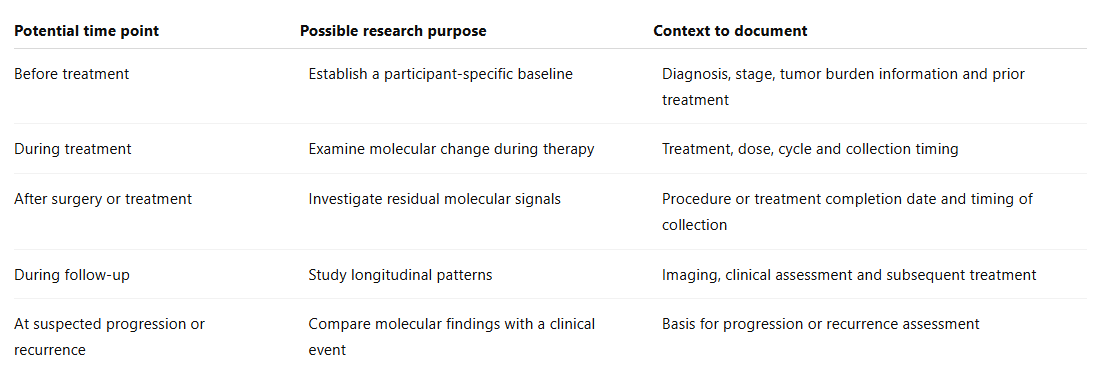
These are examples rather than universal requirements. Time points should be selected according to the study question, tumor biology, assay characteristics and protocol.
Longitudinal analysis depends on comparability between time points. If collection or processing conditions change during a study, it can become difficult to distinguish biological change from preanalytical variation.
Collection timing
Each sampling window should be defined relative to the relevant clinical event. The protocol should specify whether a sample is collected before treatment, after a particular dose or cycle, following surgery, during surveillance or at another study-defined point.
FDA’s November 2024 final guidance on ctDNA in early-stage solid-tumor drug development discusses standardization and harmonization of ctDNA assays and methodologies in the curative-intent setting. The appropriate sampling strategy remains dependent on the proposed context of use.
Blood collection and plasma preparation
The protocol should establish the collection tube, required blood volume, mixing instructions, permitted interval before processing, centrifugation procedure, plasma aliquot volume and acceptable storage conditions. These requirements should remain consistent across sites and visits whenever the study design requires comparable serial samples.
BLOODPAC has identified minimum preanalytical technical data elements for cell-free DNA research, reinforcing the importance of documenting variables that can affect assay performance, reproducibility and interpretation.
Specimen identity and traceability
Every aliquot should remain connected to the correct participant, visit and collection event. Essential records may include collection and processing timestamps, tube type, aliquot identifiers, storage history, shipment conditions and documented deviations.
Clinical context
A ctDNA result is more informative when it can be interpreted alongside relevant clinical data. Depending on the protocol, this may include:
- Confirmed diagnosis and tumor type
- Disease stage and disease status
- Treatment history and current therapy
- Surgery, infusion or dosing dates
- Imaging or other response assessments
- Relevant pathology or molecular findings
- Progression, recurrence or follow-up information
Data fields and allowable collection windows should be defined before enrollment so that sites collect information consistently.
Time points should be chosen according to the biological and clinical question the study is designed to answer.
Diagnostic developers may focus on whether specimens represent the assay’s intended-use population, relevant disease states and appropriate comparator groups. Biopharmaceutical teams may prioritize baseline status, on-treatment changes, post-treatment observations or correlations with longer-term clinical outcomes.
Before finalizing the schedule, teams should ask:
1. What decision or hypothesis will each time point support?
2. Which clinical event anchors the collection window?
3. Is a pretreatment baseline required for interpretation?
4. How much blood and plasma are required for all planned analyses?
5. Will repeat or orthogonal testing be needed?
6. What happens if a visit is delayed, missed or collected outside the window?
7. Are the same collection and processing procedures feasible at every site?
Collecting more frequently does not automatically create a stronger study. Each draw should have a defined purpose, and the schedule should remain feasible for participants and clinical sites.
Multisite longitudinal studies combine two sources of complexity: repeated visits and variation between collection locations. Common operational risks include:
- Inconsistent interpretation of collection windows
- Different tube types or processing equipment
- Delays between blood collection and plasma separation
- Variation in centrifugation, aliquoting or freezing procedures
- Missing clinical data at one or more visits
- Insufficient volume for planned testing
- Temperature excursions during shipment
- Participant withdrawal or missed follow-up visits
A central collection manual, standardized kits, site training, documented acceptance criteria and a defined deviation pathway can help align execution across locations. Feasibility should be assessed before enrollment, particularly when the study requires narrow collection windows or specialized processing.
Longitudinal studies should anticipate incomplete series. The protocol and statistical analysis plan should define how missed visits, out-of-window collections, insufficient volume and sample-quality issues will be documented and evaluated.
Operational planning should also clarify whether a participant remains valuable to the study if one time point is unavailable. This decision may differ between exploratory research, method-comparison work and a clinical-validation program.
Maintaining visibility into collection status can help sponsors identify gaps while there may still be an opportunity to complete a future visit or resolve missing information.
A coordinated laboratory workflow can reduce differences in how serial samples are received, accessioned, processed, tested and stored. Study-specific procedures may address:
- Shipment receipt and temperature review
- Sample identity and visit reconciliation
- Aliquoting and test assignment
- Specimen acceptance and rejection criteria
- Data transfer and query management
- Storage location and temperature monitoring
- Remaining-volume tracking
- Controlled retrieval for future testing
Biostorage planning is particularly important when samples may be tested in batches, used for future exploratory analyses or compared after longer-term outcome data become available. The retention plan should remain consistent with the protocol, informed consent and applicable requirements
Longitudinal ctDNA research is not simply a series of blood draws. It is a connected workflow involving participant eligibility, clinically meaningful time points, consistent preanalytics, laboratory operations, clinical data and long-term sample management.
Early planning helps diagnostic and biopharmaceutical teams determine whether the proposed collection is scientifically appropriate and operationally feasible. It also helps sites understand exactly what must happen at every visit.
Boca Bio supports diagnostics and biopharmaceutical companies through sponsor-defined prospective biospecimen collections, clinical research services, central laboratory testing and biostorage. Our teams can help translate protocol requirements into a coordinated collection and laboratory workflow.
A longitudinal collection obtains specimens from the same participant at multiple predefined time points. Samples are linked to study events and relevant clinical data so researchers can evaluate changes over time.
ctDNA circulates within the cell-free DNA fraction of blood and is commonly analyzed using plasma. The appropriate specimen and processing method depend on the assay, study design and intended use.
A pretreatment or pre-intervention baseline can help interpret later measurements, but its necessity depends on the research question and context of use. The time point should be defined prospectively in the protocol.
Important variables may include tube type, blood volume, time to processing, centrifugation, plasma aliquoting, storage temperature, freeze-thaw history and shipment conditions. Requirements should be defined for the specific assay and study.
Yes, when the required participant population and procedures are feasible across the selected sites. Standardized collection materials, training, documentation and laboratory coordination can help align execution.
Storage conditions, aliquot volumes, retention periods and permitted future uses should be defined according to the protocol, assay requirements, consent and applicable regulations. Specific stability requirements should be scientifically justified.
Bullet Point List Lorem ipsum dolor
Lorem ipsum dolor sit amet
Fusce tristique lorem non justo malesuada, et ullamcorper risus volutpat
Cras fringilla urna vel metus lobortis, eget egestas nulla efficias fringilla urna vel mngilla urna vel metus lobortis, eget egestas nulla efficias fringilla urna vel metus lobortie
Fusce tristique lorem non justo malesuada, et ullamcorper risus volutpat


