Boca BioSpecimen360 is here, a simpler way to source biospecimens.
Learn More

November 10, 2026
Urine specimens for diagnostic research should be defined by more than sample type and volume.
IVD developers and laboratory teams should specify the collection method, container, additives, processing history, storage conditions and supporting clinical information needed for the intended assay. These requirements help determine whether existing inventory is suitable or a prospective collection is needed.
Urine is used across molecular diagnostics, clinical chemistry, microbiology and other laboratory applications. Each application can require a different collection and handling approach. CLSI’s PRE05—Processes for the Collection of Urine Specimens addresses multiple collection techniques and their use across these testing disciplines.
For diagnostic developers, this creates a practical sourcing challenge: two specimens labeled “urine” may have different collection histories and may not meet the same research requirements.
A useful procurement request connects the specimen to the analytical question:
- What will the assay measure?
- Which population should the specimens represent?
- Which collection and processing conditions are essential?
- What information must accompany each sample?
Defining these requirements before sourcing gives procurement and laboratory teams a clearer basis for evaluating feasibility.
Terms describing urine collection can refer to different aspects of the procedure.
First-catch urine describes the initial portion of the urine stream. First-morning urine describes when the specimen is collected. A request should distinguish the collection fraction from the time of collection.
Application-specific guidance illustrates why this matters:
- CDC identifies first-catch urine as an optimal specimen for chlamydia screening by nucleic acid amplification testing in men.
- For urine albumin-to-creatinine ratio assessment, NIDDK prefers a first-morning specimen and accepts a random specimen when a first-morning collection is unavailable.
These examples address different testing applications. Neither establishes a universal collection method for urine-based diagnostic research.
For an established assay, review its applicable instructions. For an investigational assay, define and evaluate the collection conditions within the development plan.
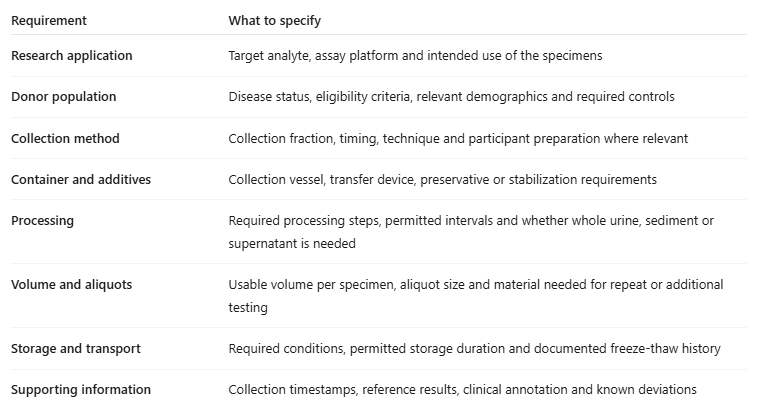
Separate required criteria from preferred characteristics. This helps the sourcing team identify where flexibility exists without changing the study’s essential requirements.
A container or preservative selected for one workflow should not automatically be assumed suitable for another.
Before procurement, document whether the study requires an additive-free specimen, a specific collection system or a defined stabilization approach. Establish whether specimens will be tested directly or undergo extraction, centrifugation or another preparation step.
For retrospective inventory, ask what is documented about the original collection and subsequent processing. For prospective collections, incorporate the agreed requirements into site instructions.
The objective is a collection process that supports the assay’s defined needs.
There is no single storage condition or stability window that should be applied to every urine specimen and research application.
Specify the handling conditions supported by the assay instructions, relevant evidence or study-specific evaluation. Requests should address:
- Time from collection to processing or stabilization
- Storage and transportation conditions
- Duration of storage
- Aliquoting history
- Known thawing events
- Handling deviations and their documentation
“Frozen urine” alone does not describe the complete storage history. When information is unavailable, document the gap and determine whether it affects suitability for the planned analysis.
For diagnostic evaluation, a positive or negative designation should be accompanied by the information the study requires to interpret that designation.
Depending on the project, this may include the reference method, result, testing date and relationship between reference testing and specimen collection.
For quantitative research, specify the relevant laboratory measurements and units. For disease-specific cohorts, identify the clinical evidence required to support eligibility.
Distinguish a documented negative result from missing information. Define how incomplete or unresolved records will be handled before selecting specimens.
Retrospective specimens may be appropriate when existing material and its documentation satisfy the study requirements. Review collection method, processing, remaining volume, storage history and available reference information before selection.
Prospective collections may be appropriate when the project requires conditions that existing inventory cannot meet—for example, a particular collection system, defined processing steps or additional clinical information.
The decision should follow a documented gap assessment. Identify which requirements existing inventory meets, which remain uncertain and which require a new collection.
Boca Bio supports diagnostics and biopharma research through biospecimen inventory, custom procurement and prospective collections. Project requirements can include the collection method, characterization and timing needed for the study.
When preparing a request, share the assay objective, donor criteria, collection specifications, usable volume, required data and timeline. This gives the team a basis for assessing inventory suitability and collection feasibility.
Discuss your urine-specimen procurement and prospective collection requirements with Boca Bio.
Provide the research application, donor criteria, collection method, container, processing requirements, volume, storage conditions and supporting data. Identify which requirements are essential and where alternatives may be considered.
No. First-catch describes the initial portion of the urine stream. First-morning describes collection timing. A study may need to specify both.
Potentially. Suitability depends on the intended analysis, documented collection and storage history, available volume and supporting information. Specimen age alone does not establish suitability.
Consider prospective collection when available inventory cannot meet essential requirements, such as a specified collection device, processing procedure, donor population or required clinical information.
Bullet Point List Lorem ipsum dolor
Lorem ipsum dolor sit amet
Fusce tristique lorem non justo malesuada, et ullamcorper risus volutpat
Cras fringilla urna vel metus lobortis, eget egestas nulla efficias fringilla urna vel mngilla urna vel metus lobortis, eget egestas nulla efficias fringilla urna vel metus lobortie
Fusce tristique lorem non justo malesuada, et ullamcorper risus volutpat


