Point-of-care comparative study supports successful 510(k) clearance with CLIA waiver designation
April 28, 2026
Bringing a new diagnostic device to market is rarely straightforward. For companies developing point-of-care solutions, demonstrating substantial equivalence to an existing device while maintaining speed, quality, and cost efficiency can be a significant hurdle.
In this case, a small biotech company developing a novel point-of-care diagnostic for respiratory infections partnered with Boca Biolistics to navigate the FDA 510(k) pathway. The goal was clear: generate robust clinical and laboratory evidence to support regulatory submission while minimizing delays.
The Challenge: Proving Equivalence Without Slowing Down Development
The FDA’s 510(k) process requires clear evidence that an investigational product performs equivalently to a predicate device already on the market. This typically involves:
-Recruiting a sufficient number of eligible subjects -Conducting parallel testing across clinical and laboratory settings -Managing multiple vendors and workflows
These requirements can introduce complexity, extend timelines, and increase costs. For this study, an estimated 850 subjects with suspected respiratory infections were needed to meet positivity targets, adding further pressure to recruitment and execution timelines.
The Approach: Integrated Clinical and Laboratory Execution
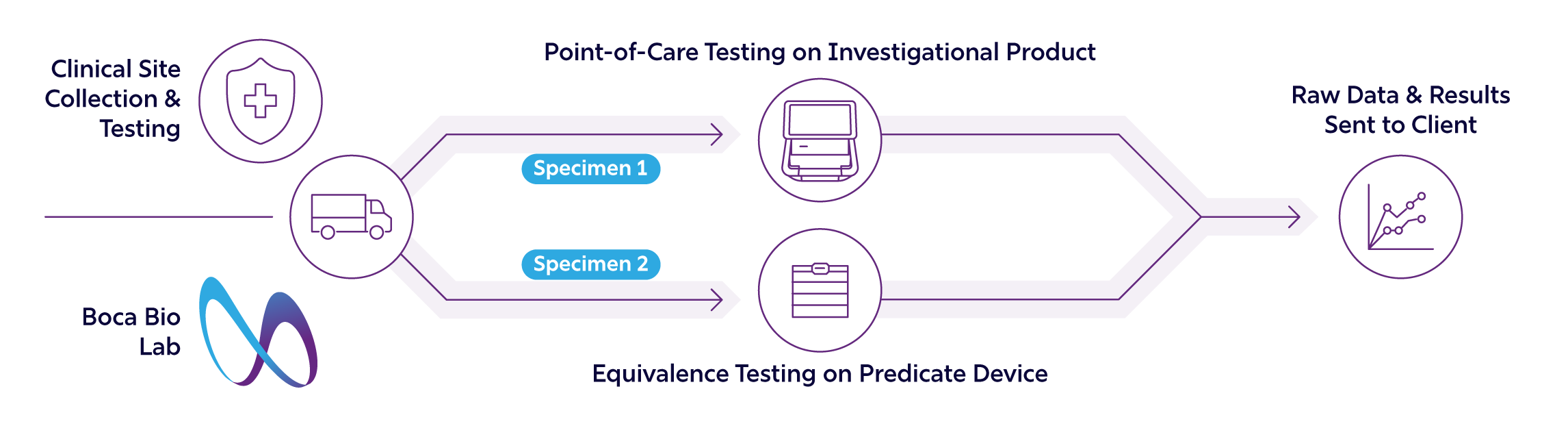
Boca Biolistics implemented a fully integrated study design that combined clinical site operations with centralized laboratory testing. The study was conducted across six clinical sites and included subjects aged 12 months and older presenting with symptoms of respiratory infection.
Each participant provided two nasopharyngeal swabs:
•One swab was tested on-site using the investigational point-of-care device •The second swab was shipped to Boca Bio’s laboratory for predicate device testing
This dual-sample approach ensured a direct, controlled comparison between the investigational product and the existing standard.
To support regulatory requirements, clinical site staff were trained to operate within a CLIA-waived environment, aligning study conditions with real-world point-of-care use.
Speed and Efficiency Without Compromise
One of the defining aspects of this study was operational efficiency.
Despite being conducted outside peak respiratory season, the study achieved its recruitment goals with only 700 subjects, fewer than initially projected. Even more notably, the entire study was completed in just four months.
Laboratory performance also played a critical role. Equivalence testing was completed within two days of sample receipt, and raw data was delivered promptly to the client. This rapid turnaround enabled faster analysis and submission readiness.
Behind the scenes, rigorous quality control, inventory management, and chain-of-custody protocols ensured full sample traceability and data integrity throughout the process.
The Outcome: Successful 510(k) Clearance and CLIA Waiver
Fusce tristique lorem non justo malesuada, et ullamcorper risus volutpat
Cras fringilla urna vel metus lobortis, eget egestas nulla efficias fringilla urna vel mngilla urna vel metus lobortis, eget egestas nulla efficias fringilla urna vel metus lobortie
Fusce tristique lorem non justo malesuada, et ullamcorper risus volutpat


 Contact Us


