Boca BioSpecimen360 is here, a simpler way to source biospecimens.
Learn More

August 13, 2026
How a targeted RHD and matched healthy-control collection was completed in approximately two months
Result: A 10-donor serum collection completed nearly one month faster than anticipated while meeting detailed eligibility, matching, and data requirements.
For rheumatic heart disease (RHD) research, the value of a serum cohort depends on more than sample count. Disease history, recent activity, echocardiographic status, control matching, and accompanying clinical data all shape whether researchers can interpret biological signals with confidence.
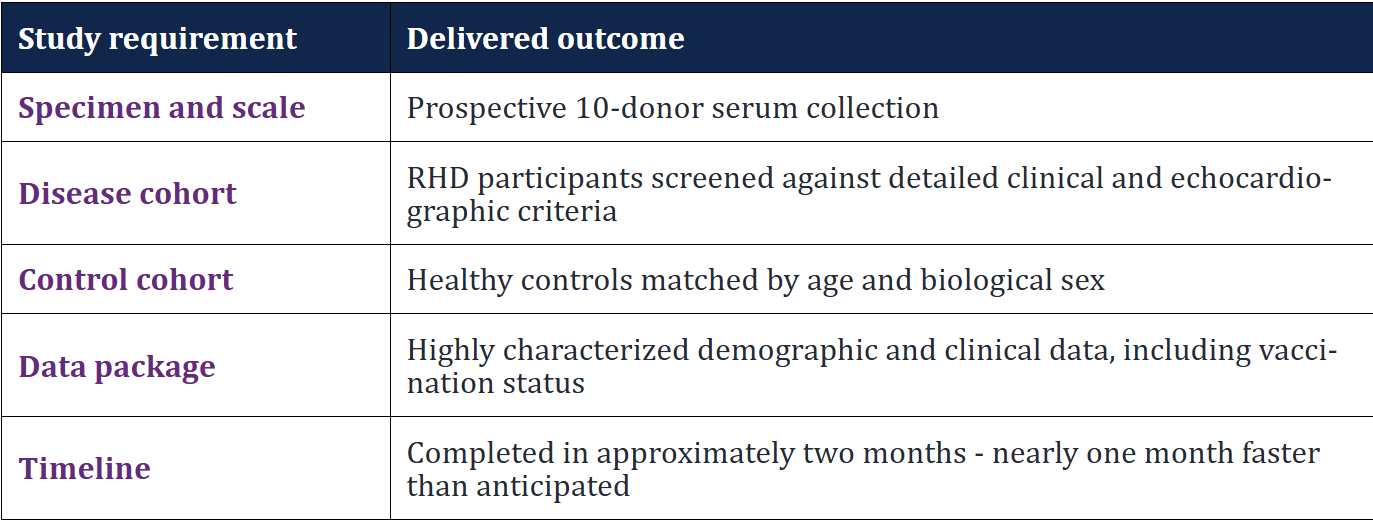
In this prospective study, a sponsor needed serum from a tightly defined RHD population together with age- and sex-matched healthy controls. Boca Bio completed the 10-donor collection at a site outside the United States in approximately two months - nearly one month ahead of the anticipated timeline - while meeting the sponsor’s eligibility and data requirements.
Rheumatic heart disease is a chronic, immune-mediated cardiovascular condition that can develop after acute rheumatic fever associated with Group A Streptococcus infection. Recurrent inflammatory episodes may lead to progressive, permanent heart-valve damage. For research teams investigating disease mechanisms or potential biomarkers, that clinical complexity makes cohort definition especially important.
A specimen labelled “RHD” is not automatically fit for every study. Researchers may need evidence of prior acute rheumatic fever, documented streptococcal history, recent disease activity, and echocardiographic confirmation of advanced disease. Without these data, meaningful biological differences may be harder to separate from variation in disease status, medical history, or the general population.
The sponsor’s inclusion framework required a highly specific RHD population. Participants needed a documented history consistent with the Jones Criteria for acute rheumatic fever, a recent acute rheumatic fever episode, Stage C or D RHD, and immunocompetent status. Clinical and echocardiographic screening therefore had to support the requested disease definition rather than relying on diagnosis alone.
The healthy-control arm introduced a second layer of complexity. Controls had to be matched by age and biological sex, helping establish a more relevant baseline for comparison. The collection also required highly characterized demographic and clinical information, including vaccination status.
Boca Bio conducted the collection through an outside-the-U.S. site using the sponsor’s detailed eligibility framework. The prospective design allowed recruitment and data capture to be aligned with the study requirements from the outset.
- A 10-donor serum collection designed around the requested RHD and healthy-control cohorts
- RHD screening against detailed clinical and echocardiographic criteria
- Age- and biological-sex matching for healthy controls
- Collection of highly characterized demographic and clinical data, including vaccination status
- Execution through a site outside the United States
This alignment across eligibility, matching, and annotation was central to the project. It supported a cohort suited to comparative research while keeping the study focused on the sponsor’s specific scientific question.
The prospective RHD and healthy-control serum collection was completed in approximately two months. That was nearly one month faster than the anticipated timeline, without relaxing the sponsor’s specified eligibility, matching, or data requirements.
Prospective biospecimen collection is most useful when operational execution and scientific specificity are planned together. For narrowly defined cardiovascular cohorts, four practices are especially important:
- Translate the protocol into screenable criteria. Disease labels should be supported by the clinical history and diagnostic evidence the study actually requires.
- Define controls as carefully as cases. Matching variables and exclusion criteria influence the strength of downstream comparisons.
- Specify the accompanying data before enrollment. Demographic, clinical, diagnostic, and treatment-related fields should reflect the analysis plan.
- Build timelines around cohort rarity and evidence requirements. A realistic recruitment plan should account for both participant identification and documentation review.
This study demonstrates that a narrowly specified collection can move efficiently when the site, screening framework, matching strategy, and data requirements are aligned before recruitment begins.
If your program requires a disease-specific cohort, matched controls, or defined clinical annotation, the first step is to translate the scientific objective into a practical collection specification. Boca Bio can discuss prospective collection requirements, cohort feasibility, and the data needed to support your research question.
The project involved a prospective 10-donor serum collection for a rheumatic heart disease cohort and age- and sex-matched healthy controls.
The sponsor’s framework included acute rheumatic fever history consistent with the Jones Criteria, a recent acute rheumatic fever episode, Stage C or D RHD, immunocompetent status, and supporting clinical and echocardiographic review.
Age- and biological-sex matching provided a more relevant baseline for distinguishing disease-associated biological signals from normal variation in comparative research.
The collection was completed in approximately two months, nearly one month faster than the anticipated timeline.
The collection included highly characterized demographic and clinical information, including vaccination status. The source case study does not enumerate every field in the data package.
Bullet Point List Lorem ipsum dolor
Lorem ipsum dolor sit amet
Fusce tristique lorem non justo malesuada, et ullamcorper risus volutpat
Cras fringilla urna vel metus lobortis, eget egestas nulla efficias fringilla urna vel mngilla urna vel metus lobortis, eget egestas nulla efficias fringilla urna vel metus lobortie
Fusce tristique lorem non justo malesuada, et ullamcorper risus volutpat


